10 Krónur – Iceland’s First Banknote Series (1886)
A Detailed Historical Overview
The Icelandic 10 krónur banknote of 1886 belongs to the very first series of Icelandic paper money ever issued. As one of the foundational notes printed for Landssjóður Íslands (the National Treasury of Iceland), it represents a crucial step in the evolution of Iceland’s monetary identity during the late 19th century.
A New Era of Icelandic Currency
Following the law passed on 18 September 1885, Iceland received the authority to issue its own paper money for the first time. The resulting series—consisting of 5, 10, 50, and 100 krónur—was printed in Copenhagen by H. H. Thiele, Denmark’s leading security printer. Each denomination was designed by the respected Danish artist Henrik Olrik.
The 10 krónur note held a middle position in this series, making it widely used and historically significant.
Design & Artistic Details
Obverse (Front)
-
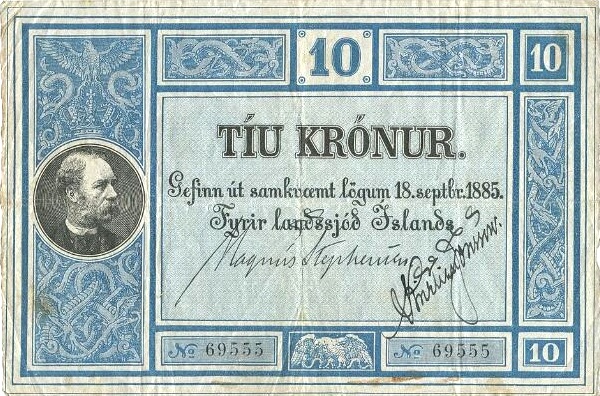
Prominent portrait of King Christian IX, symbolizing Iceland’s political connection with Denmark at the time.
-
Decorative border work featuring Icelandic design elements.
-
Icelandic text indicating legal authorization:
„Gefinn út samkvæmt lögum 18. septbr. 1885. Fyrir Landssjóð Íslands.” -
Watermark consisting of the letters “ÍL” (Íslands Landssjóður).
-
Distinctive brown color tone, used to differentiate it from the 5 krónur (gray) and the higher denominations.
Reverse (Back)
-
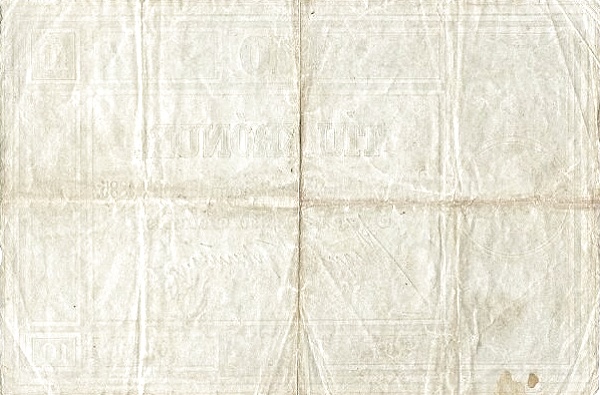
As with all notes of the 1886 series, the reverse side is blank, with no printed design.
Specifications
-
Size: Approx. 165 × 105 mm
-
Printer: H. H. Thiele, Copenhagen
-
Designer: Henrik Olrik
-
Catalog Number: Pick P-2
-
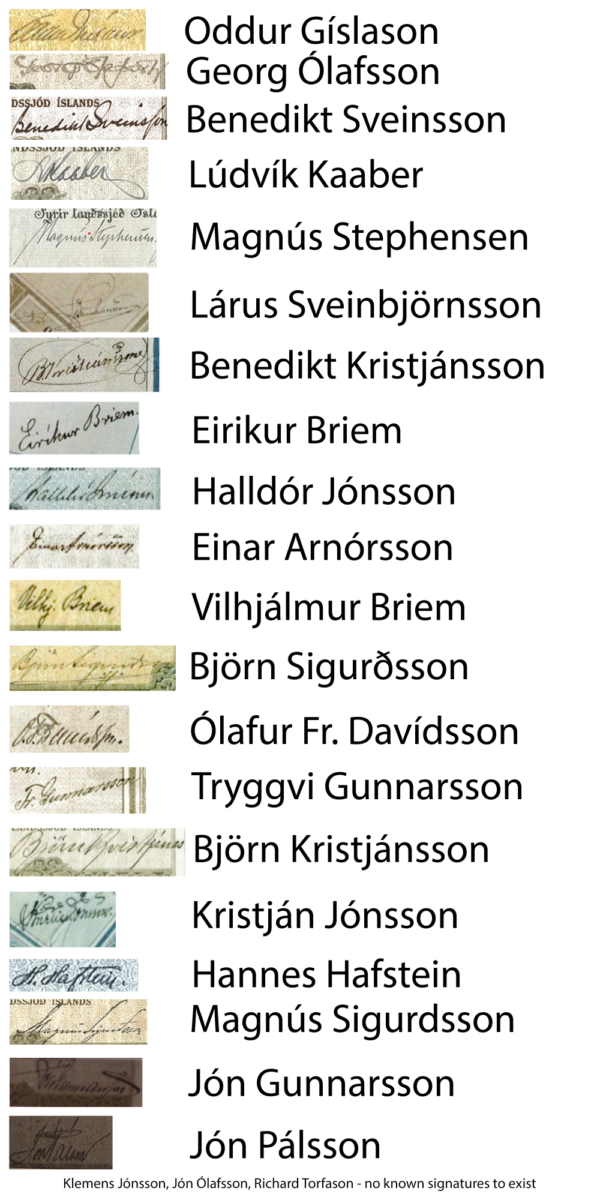
Signature Variants: Multiple combinations exist, signed by authorized Icelandic treasury officials.
Issuance & Circulation
The 10 krónur note was first released on 21 September 1886, the same date as the rest of the inaugural series.
Notes arrived from Denmark unsigned and were manually signed in Iceland before being put into circulation—an important detail that slowed distribution and created variation in signature combinations.
During this period, Iceland’s economy still relied heavily on Danish oversight, making this treasury-issued paper money a significant milestone toward financial autonomy.
Withdrawal
This note remained in circulation until it was officially withdrawn on 31 January 1909, when later issues and improved banknote designs replaced the original 1886 series.
10 Kronur 1886 P-2 Iceland
Signatures guide for Icelandic currency of the period