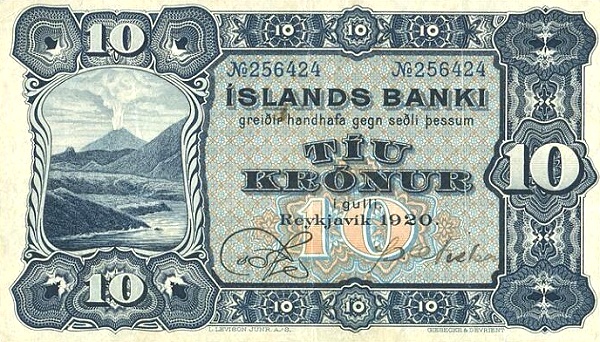
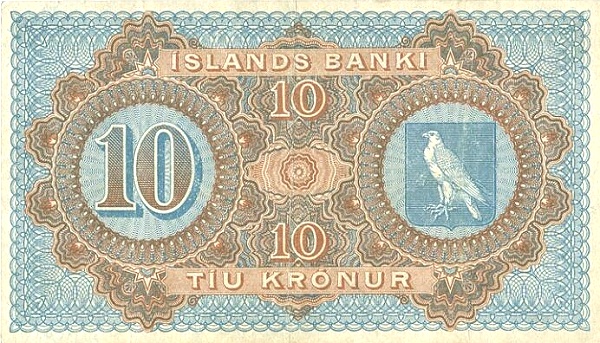
10 Krónur 1920 – Iceland (Pick P-16)
A transitional Icelandic banknote marking the shift from private-bank currency to state-supervised monetary control
The 10 Krónur 1920 banknote (Pick P-16) is one of the most historically important early 20th-century Icelandic notes. Issued shortly after the bankruptcy of Íslandsbanki in 1919, it represents the temporary government-supervised currency system that operated until Iceland’s central banking framework stabilized.
Like the 5 krónur note of the same year, the 10 krónur 1920 is an original newly printed design, not an overprint on earlier stock. It is one of the last notes produced before Landsbanki Íslands gained full authority to issue currency.
Key Details
-
Denomination: 10 Krónur
-
Year of Issue: 1920
-
Pick Number: P-16
-
Issuer: Transitional government-supervised authority following the failure of Íslandsbanki
-
Print Type: Original engraved banknote; no overprinted varieties
-
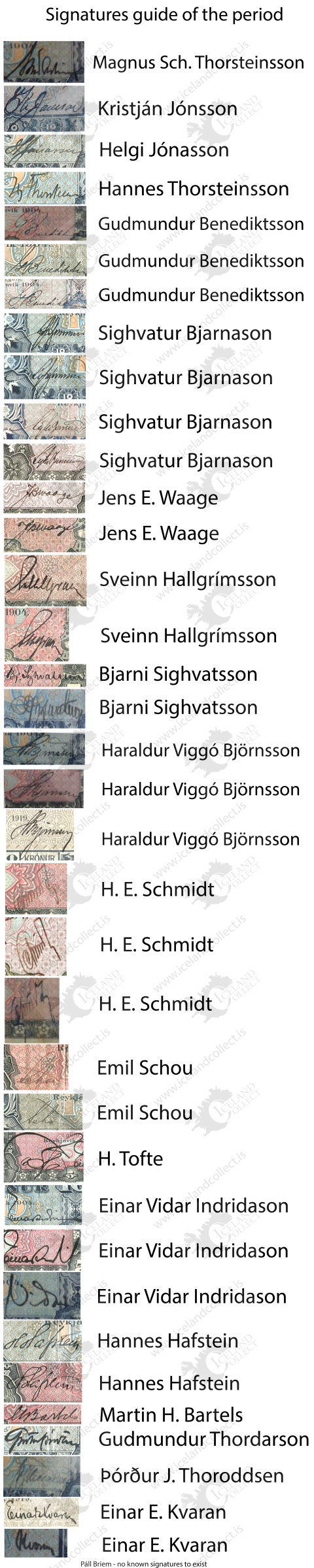
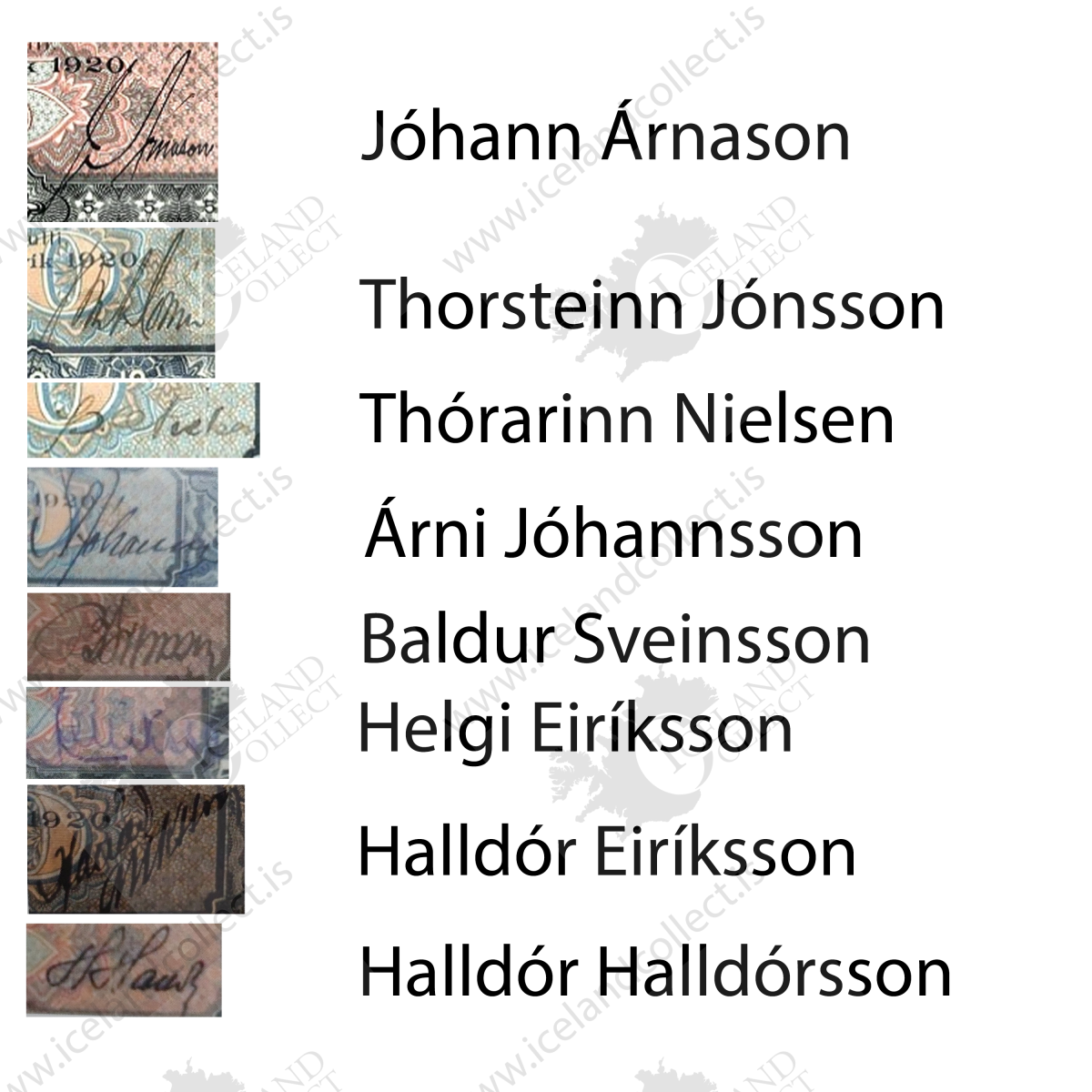
Signatures: Several varieties exist based on the government administrators validating the post-bankruptcy circulation
-
Rarity: Scarce, especially in higher grades
Historical Context
The year 1920 was a turning point in Icelandic currency development. With Íslandsbanki’s collapse in 1919, the country lost its primary private banknote issuer. To maintain a functioning money supply:
-
The Icelandic government took temporary control over currency authorization.
-
New denominations were printed under state supervision, including the 10 Krónur 1920.
-
These notes served as a bridge until Iceland developed a more centralized, stable banknote system in the early 1920s.
The 1920 issues (5 kr. and 10 kr.) are therefore transitional pieces — produced in limited quantities and carrying significant historical relevance.
Design Description
Obverse (Front)
-
Central inscription “Tíu Krónur” (Ten Kronur)
-
Dominant “10” within an ornate decorative frame
-
Intricate geometric and Nordic-style patterns typical of early Icelandic banknotes
-
Serial numbers printed in red or black, depending on variety
-
Signatures of officials overseeing Iceland’s temporary currency administration
The design language follows the classical style of previous Islandsbanki notes, but all engraving work was prepared specifically for this issue.
Reverse (Back)
-
Symmetrical engraved artwork featuring scrollwork and stylized foliage
-
Large, bold “10” denomination at center
-
Icelandic text confirming legal tender status
-
Clean, uncluttered design emphasizing clarity and formality
-
No overprint or reused plate elements from earlier notes — confirmed as a unique print
Paper & Production Characteristics
-
Printed on firm early-20th-century banknote paper
-
Strong intaglio linework with raised ink texture
-
Moderate color palette (greys, browns, or greenish tones depending on surviving examples)
-
Crisp security-style borders with fine engraving
Rarity & Collector Notes
The 10 Krónur 1920 (P-16) is significantly scarcer than the more common 1904–1919 Islandsbanki issues. Reasons:
-
Printed in relatively small quantities
-
Short period of circulation
-
Many notes were redeemed and destroyed once the new monetary structure was established
-
Surviving notes in higher condition (VF–EF or better) are particularly rare
Collectors value P-16 for:
-
Its transitional historical importance
-
Its low survival rate
-
Its unique design not reused on earlier or later notes
-
The shift it represents between private and state-controlled Icelandic money
Certified examples (PMG / PCGS) in high grade are sought after and often achieve strong auction results.
10 Krónur 1920 – Iceland (Pick P-16)
Signatures guide for Icelandic currency of the period